
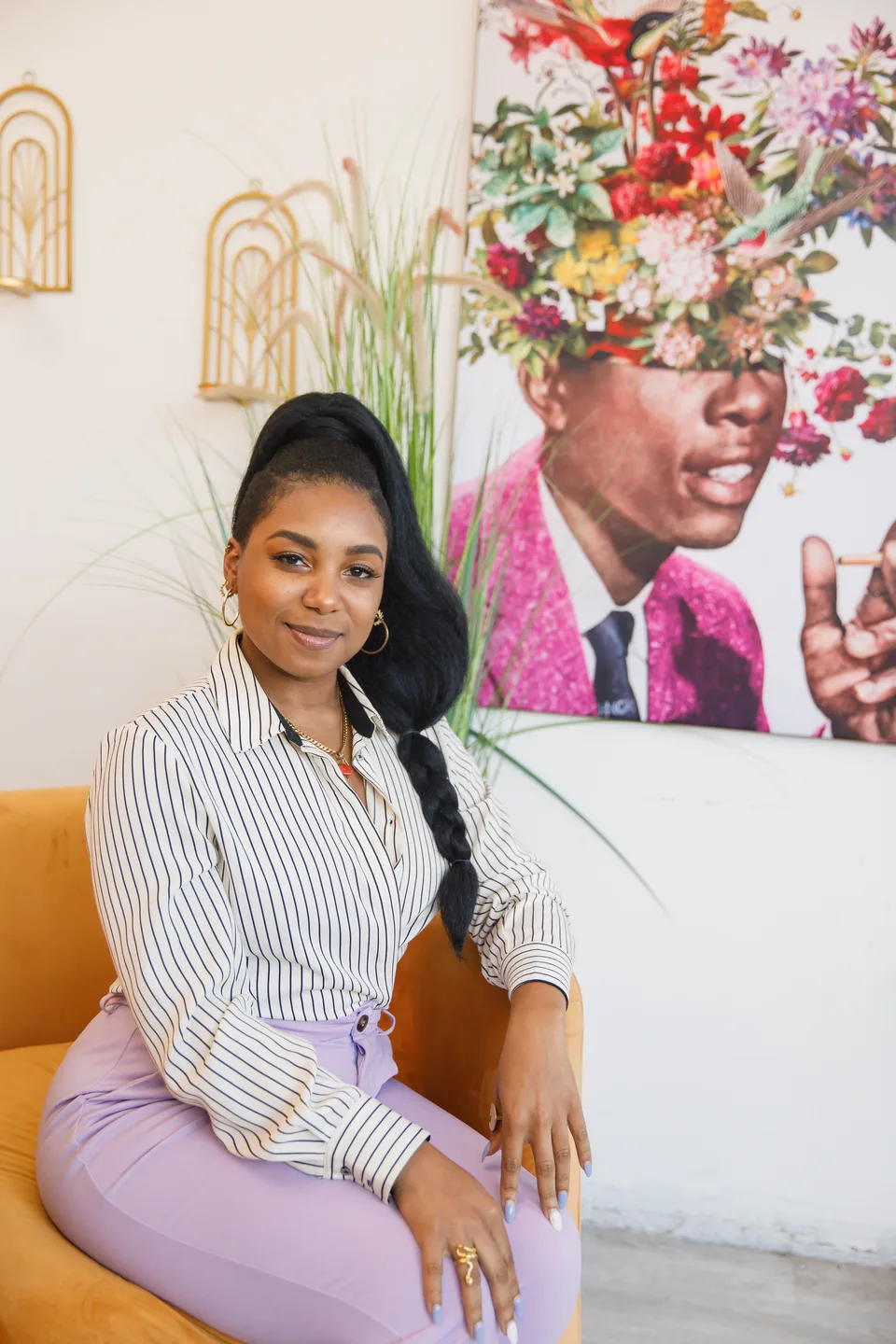
A stylishly dressed woman seated on an orange velvet chair, wearing a striped shirt and lavender trousers, with a floral painting behind her

Styling as Self-Expression: Dressing for the Person You're Becoming

When most people think about personal styling, they think about aesthetics. Trends. Flattering silhouettes. The right outfit for the right occasion.

And yes — all of that is part of the work.

But that framing leaves something important out. The most transformative styling work I do with clients is not about clothes at all. It’s about identity, permission, and the act of choosing to show up as yourself — fully, intentionally, on purpose.


What Your Clothes Are Actually Saying

We all send signals through how we dress. This is not a political statement — it’s just true. Before we speak, before we move, before we decide whether to take up space or make ourselves small in a room, we have already communicated something through what we’re wearing.

More importantly, we have communicated something to ourselves.

This is what gets overlooked in conversations about personal style. The relationship between what you wear and how you feel is not one-directional. It’s a loop. Your internal state influences what you reach for in the morning, and what you reach for in the morning influences your internal state through the rest of the day.

The question is whether you’re in that loop consciously or not.


Dressing From Depletion vs. Dressing From Self

There’s a particular version of getting dressed that most of us know well: standing in front of a closet full of clothes, feeling overwhelmed, reaching for the thing that requires the least decision or risk. The reliable option. The safe one. The one that won’t draw attention.

This is dressing from depletion. It’s practical, it gets you out the door, and there is nothing wrong with it on a hard Tuesday. But when it becomes the default — when the question “what do I wear?” is perpetually answered by “whatever is easiest” — something has gone quiet. Getting Dressed When Life Feels Heavy looks specifically at what this version of dressing reflects — and what tending to it can mean.

The version of getting dressed that I find genuinely transformative is different. It begins not with the question “what is appropriate?” or “what will I be judged well for wearing?” but with a different question altogether: Who am I today, and what does that person look like?

This is dressing from self. It requires slightly more attention and a willingness to make a choice rather than default. But it also creates, over time, a different relationship with how you inhabit your days.


The Person You’re Becoming

One of the most interesting conversations I have with styling clients is about the gap between how they currently dress and how they’d dress if they weren’t managing other people’s expectations of them.

Sometimes there’s very little gap. Sometimes the gap is significant. And the gap itself is useful information.

It reveals things like: where I’ve shrunk myself to be more palatable. Where I’ve made decisions about visibility based on assumptions about who gets to look a certain way. Where the clothes I reach for are telling an old story that I’m not sure still belongs to me.

I don’t work with clients to make them look like someone else, or to update them with a trend, or to dress them for the person they used to be. I work with clients to help them dress for who they are becoming. For those navigating career transitions or new professional chapters, How to Dress for the Life You’re Trying to Step Into addresses that specific intersection directly.

That might mean a wardrobe that takes up more space, literally and figuratively. It might mean more color, or less. More structure, or more ease. It might mean finally letting go of clothes that were “perfectly fine” but that never actually made you feel the way you deserved to feel in them.


Styling and Embodied Confidence

What I observe — consistently, with clients across different backgrounds and different styling goals — is that when someone starts dressing with intentionality and self-permission, something happens to how they inhabit their body.

They stand differently. They move differently. They walk into rooms with a quality of presence that was there all along but was harder to access.

This is not because clothes have magical powers. It’s because the act of choosing to see yourself, to treat your daily presentation as worth attending to, signals something internally. It says: I am worth the care. I am worth showing up for. The person I am becoming deserves to be dressed.

That signal, repeated daily, compounds. It begins to feel not like performance but like truth.


What Personal Styling With Me Looks Like

When I work with styling clients, we move slowly. We begin with conversation — about what they want to feel, where they want to go, what they’re ready to step into. We talk about what has worked and what has never quite fit, even if the clothes technically fit fine.

From there, we build something together. Not a rigid wardrobe system or a capsule formula. A language — a personal visual language that is consistent with who you are and responsive to where you’re heading.

Across Metro Atlanta, I work with professionals, creatives, and individuals who are in the middle of becoming something new. I work with clients navigating major transitions (new roles, new cities, new chapters), clients who want help with styling for specific events or needs, clients who feel ready to stop getting dressed on autopilot — and those who want their vacation and travel style to finally feel like relief instead of performance.

If any of this resonates, explore personal styling with Ally or let’s have a conversation. Getting dressed every day is an opportunity. I’d love to help you use it.


Begin with a consultation. Book here.

Free

Embodied Ally

Coping Guide for 3 Myths Keeping You Stressed

A somatic + reflective approach to stress awareness

Free Resource

Download the free stress guide.

Coping Guide for 3 Myths Keeping You Stressed

Start reframing your relationship with stress through reflection, somatic awareness, and practical prompts created by Embodied Ally.

The ideas here are just the beginning.

If something in this post resonated with you, the next step is a real conversation.